Episode Transcript
[00:00:00] Speaker A: We spent more than 25 years running parallel and somehow never met.
[00:00:04] Speaker B: And then we finally did.
[00:00:07] Speaker A: Turns out we had a lot to talk about,
[00:00:09] Speaker B: because even though our careers took us in different directions, we've both spent decades navigating business, leadership, media change, and more than a little reinvention along the way.
[00:00:21] Speaker A: And all the things you learn after spending decades figuring it out as you go.
[00:00:26] Speaker B: We don't always come at things from the same direction.
[00:00:29] Speaker A: And the more we talk, the more we realize how much our stories have overlap.
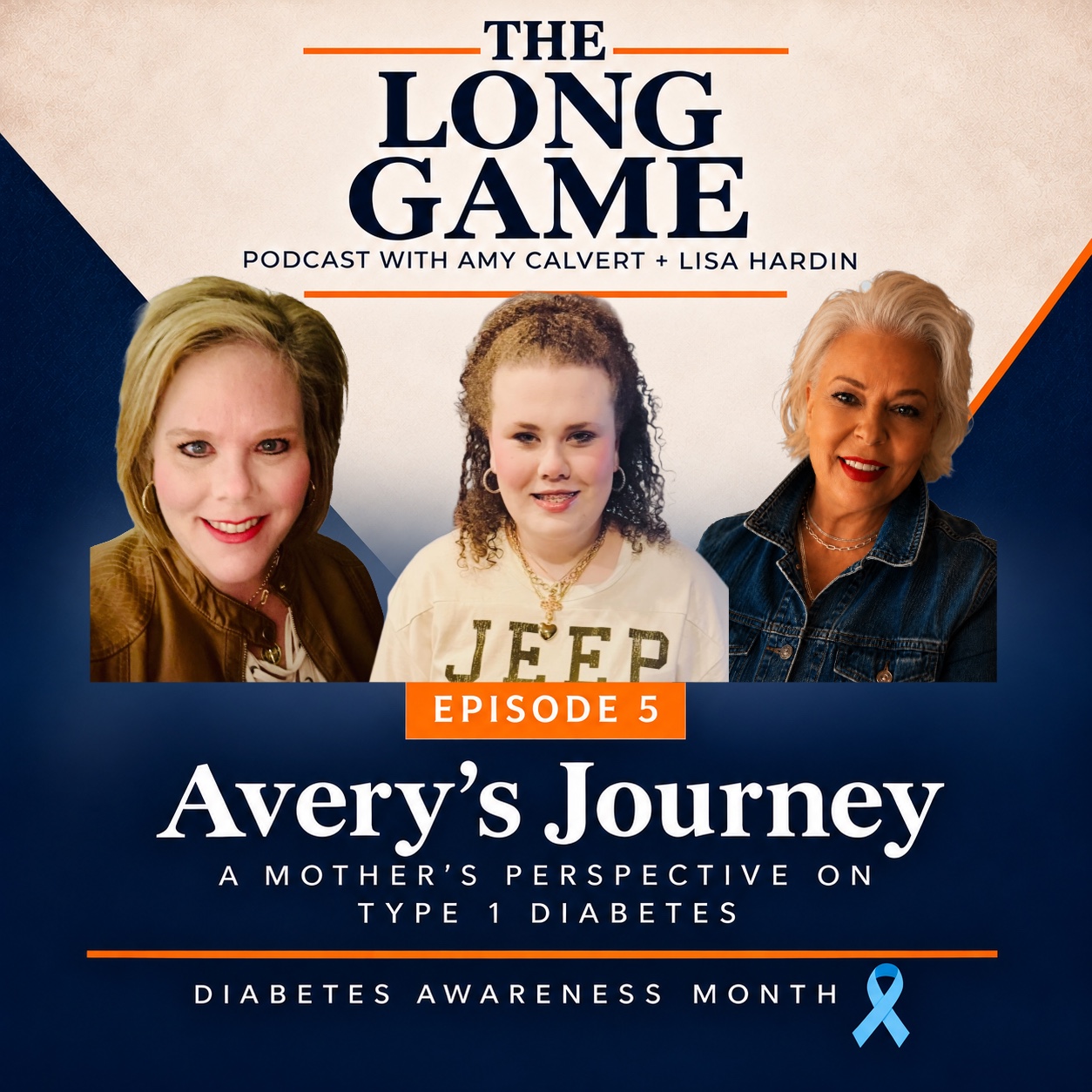
[00:00:33] Speaker B: I'm Amy Calvert.
[00:00:34] Speaker A: And I'm Lisa Hardin.
[00:00:35] Speaker B: And
[00:00:36] Speaker A: this is a long game. I'm excited
[00:00:38] Speaker B: about today's podcast.
[00:00:39] Speaker A: I am, too. I actually was thinking about a lot last night. I think it's going to be probably one of our. I'm already getting Ocean. It's not
[00:00:45] Speaker B: about me.
[00:00:45] Speaker A: I think it's going to be one of our most impactful podcasts. We do. Because I think it affects so many people.
[00:00:50] Speaker B: Yes.
[00:00:51] Speaker A: So November is Diabetes
[00:00:54] Speaker B: Awareness Month.
[00:00:55] Speaker A: Awareness Month. And so today you're going to share your story. Story. Yes. Our journey in Avery.
[00:01:00] Speaker B: Yes.
[00:01:00] Speaker A: Which I've heard some of it from you, and it overwhelms me. Why am I emotional?
I just know
[00:01:08] Speaker B: it is. It is. You know, and what's so crazy is that you don't think about it and none of us do. Like, even your cancer, you don't think about it until it hits you. Right.
And so here we are, living our lives, and then in a moment, everything is uprooted and it's changed forever. And so for us, I'll just take you back.
It was. Well, let me take you to the start. So both my girls, Avery and Kenzie, you know, you and I talk about this. My desire was to always be a mom. Like, from as a little girl, you know, up, you had different desires. You know, we all have desires that I think God places in our heart. And so once my husband, I were ready to have kids, I just thought, okay, here we go. We're gonna have kids. Didn't happen. And for years of infertility, and we. We actually lost seven pregnancies.
God blessed us with Avery and. And they were both. Actually, I like to tell both girls were from frozen embryos of mine. You know, when you do in vitro, it's. They call it fresh tries. So it's like within weeks of taking your embryo and your husband's stuff, you know, and putting it together. That's how most successful in vitro fertilizations happen. Well, for us, it didn't. And so they actually Took my fertilized embryos and froze them. So Avery and Kenzie were taken at the same time.
Frozen. Avery was actually frozen for three years, Kinsey for 10.
And so it's just amazing what doctors can do. But so we have Avery, and she's just, you know, amazing. I mean, I was just over the moon. I remember it was about. Avery was probably about 8, and we got a call from our doctor, and I was 40, going on 41 at the time. And he was like, hey, you have three embryos left, and you either have to use them. And we were working with a Christian hospital, Christian place, that the agreement was you use them or you adopt them out. Because we believed at that point it was life, you
[00:02:54] Speaker A: know?
[00:02:55] Speaker B: And so he was like, you're 40, 41. And these are the last three. I'm not sure, but. And so Chris and I really talked, and we knew we wanted more, but it's a little scary, you know? So they put all three in, and then we got Kinsey. So we joked that they're actually the same age, you know, but through Kinsey's pregnancy and me being older, it was really hard. And I remember after having Kinsey, it was 2015, and I just went through with both pregnancies, major postpartum, just very depressed, and my body was just. And having done fertility for 15 years, you're doing these crazy drugs that your body's just kind of messed up anyway.
[00:03:33] Speaker A: Just interject. Yeah. Because again, it goes back to. We talk about hormones and how it affects women, the up and down. Oh,
[00:03:41] Speaker B: yeah,
[00:03:41] Speaker A: obviously. 15 years on injection,
[00:03:44] Speaker B: several Lupron, all these different things.
[00:03:46] Speaker A: Making your hormones out of whack. And then you have the babies, and then your hormones.
[00:03:50] Speaker B: Out of whack,
[00:03:50] Speaker A: out of whack again.
[00:03:51] Speaker B: Right. So I was like,
[00:03:52] Speaker A: crazy
[00:03:53] Speaker B: cuckoo for Cocoa Puffs. I say, you know, And I. I could see that, you know,
[00:03:56] Speaker A: as you should be. I mean, that's just the nature of.
And our bodies.
[00:04:00] Speaker B: Yeah. And I remember having Kinsey and I took off 12 weeks for work, and I was. I was going back. And so this would have been December of 2015.
And I was very. I'm that helicopter mom. And we. You know, my. Our pediatrician, Dr. Rayleigh, who's amazing. Like, I will talk about him in a few minutes. He knew me. And so I'd call and be like, hey, the girls have a cold. He's like, probably a cold mom, but bring him in. You know, he was just always so nice, and it just gave me reassurance.
So I remember it was December 14th, was a Sunday. It was crazy. And Avery had her little friend stay the night. Was her first sleepover.
[00:04:38] Speaker A: How old was she?
[00:04:39] Speaker B: Eight. Okay, seven. I'm sorry. She was seven, about to turn eight in January.
[00:04:43] Speaker A: Okay.
[00:04:44] Speaker B: And her little friend Piper stayed over, and they had a great time. And I was just like, man, Avery's kind of tired. But I thought, well, you know, sleepover.
And so that Sunday, we went to bed that night, and I'm laying in bed, and Chris and I, you know, he's out, like, in two seconds. And I'm sitting, thinking, and I heard a voice say, take Avery to the doctor.
And I'm like, I thought Chris was asleep. And I look over, and I'm like, no, he's snoring. He's out. And I'm like, that's weird, huh? I. You know, you just. I heard something. Yeah. My mind's just playing jokes. So I kind of lay there, close my eyes, and then it's like me talking to you, Lisa. I heard, take Avery to the doctor. Okay. Maybe that's you. I don't know what this is, you know, but it weighed so heavily that I was like. The next morning, I told Chris about this. I'm like, I thought you were talking to me.
He's like, why would you take Avery to the doctor, maybe? And she had. I go, well, she's got this cold, I think, or she's tired, you know? He's like, amy, he's like. But he was like, you just. Okay? And I'm like, I don't know, but I'm doing it, you know? And I called Dr. Rayleigh. I remember. And he's like, I didn't tell him the story at the time, but I was like, hey, I think I need to bring Avery in. She might have something. And, you know, I'll bring Kenzie, too, because she was a little baby. And, you know, I was afraid if Avery had something. And he's like, yeah, bring him in tomorrow.
Bring him in right now at noon. I remember it was that day.
And so I remember Avery even saying, mom, I'm fine. You're always worried about me. Like, here's this little girl. She was like, you know, because she's. She just knew me and got him in the car, got there. And I remember we walked into the doctor, and Kinsey again was, you know, three and a half, four months. She's in the carrier, and Avery's walking in, and we walk by the doctor and nurse, and I. I'll never forget this. I remember them Stopping and turning around and looking at us. And I thought, that's weird. He's like, go into this office here.
And so we went in, just, you know, Avery got up on the table, and I set Kinsey down in her carrier. I remember the nurse coming in, and she said, you know what, Mom? I'm going to take Kinsey and take a look at her. And I'm like, okay.
And so again, my mind's just thinking something's weird. And I remember Dr. Rayleigh coming into the office, and, you know, he came in and gave every a high five. And he walked over to Avery and kind of leaned in, and I thought, is he smelling her? That's weird. And then I. He looked at her and he said, I want you to sit down, and this is where I'll get emotional. And I remember him looking at me and he said, okay, Amy. He said, I've called. I've called an ambulance. He goes, I don't even need to, but we're going to finger prick Avery. He goes, I'm pretty sure she's type one diabetic. And I'm like, I'm sorry, what?
And I knew enough, because a very close friend of ours, sue, who's always been a friend in our life, she had type 1 diabetes. But selfishly, I. All I knew is that we'd all go out swimming and sue would get out of the pool and have a Coke because her sugars were low or so. And I never knew much about it and never really asked, you know, she handled it so well and didn't know much, you know,
[00:07:40] Speaker A: And
[00:07:40] Speaker B: I. I panic. I go, no, no, no. Oh, no, no. We're just in. I think it's. He's like, amy, I can smell it on her. And I. I'm like, what?
And the nurse came in and finger pricked her, and Avery sugars wouldn't even read, which mean they were over 8 or 900.
And I broke down, and he said, listen, we're gonna get through this. And I just felt like our life is over.
Like, what is happening here?
And I remember calling. Chris just panicked and just screaming, avery has type one. We're going to the hospital.
And, hey, at the time, he was working about 30 minutes out of town, and he. He was like, what? And he knew just with. And I could hear the panic in his voice.
And I was trying not to freak out because Avery was watching me the whole time, but, you know, tears are just, like, falling because I'm just like, my. This is my kid, you know? And how can I take this. I don't want her to have it.
And so, you know, he immediately just kind of said, you know, we've already called the emergency room and the icu. He goes, there's going to be a process. He's like, they're going to walk you through everything, and we're going to have to slowly bring Avery sugars down, or they can have a stroke and die.
And what happens is, most kids go into a coma and die because type 1 does not present like type 1. Type 1 looks like a normal cold.
Your kid may be losing weight, but guess what? They may be out on the soccer field every day, and you don't.
As parents, we don't know that. And I'm
[00:09:13] Speaker A: like,
[00:09:13] Speaker B: how did I miss that? How would I miss this?
And so immediately, I began beating myself up. But I remember at that point, all I could say was, God, I need you, because I am not going to make it through this. You know, here this amazing kid. Am I finally get her and am I going to. You know, And I remember the ambulance showing up, and it was a pink ambulance, so Avery was like, mom, this is. And I thought, okay, God, thank you. That that happened.
And then it was just like the both of the IMSA drivers were type 1 diabetic.
So they saw the fear in me. Here I am loading up a baby in a carrier, in an ambulance. They've got my kid on a stretcher, and they're just talking to Avery and, you know, trying to make her feel. They were amazing. And I remember the lady looking at me and saying, mom, it's gonna be okay. I've had this since I was a little girl, and her life is gonna be okay.
And still I was like, you know, just shocked and panicked, and I didn't know what to do. And I remember calling my sisters and mom and saying, meet me at the hospital, because somebody's got to take the baby. You know, I don't want to take her into the emergency room and ICU. And.
And so I remember we get to St. Francis Children's Hospital, we pull in, and there are my cousins who are the charge nurses at St. Francis waiting for us. So it was like, you know, this. This relief of, okay, there's somebody else that knows Avery is going to take good care of her.
And I remember my cousin Nicole looking at me and saying, we've already got a room. We've got balloons and bears. And they brought her in and immediately transferred us to the ICU because that's kind of protocol and made Avery feel So, like, I mean, she's just at this point, wow, I'm in a pink ambulance. These people are so nice. And now I'm in a room with balloons and bears. And it was just, wow. Okay, okay. God. And then next thing I know, we're sitting there. Chris had beat us there. I don't know how. Like, he's trying to be strong because he can see I am not.
And so they get her in. Next thing I know, the doctor walks in, and Lisa, it's a girl I had babysat since she was probably three years old. Her name was Laura. And she ran. She's like, amy, I'm on duty today. I'm going to be taking care of Avery. And again, it was like, oh, my gosh. Okay. I mean, everything.
Everything.
And so she comes in. And so for five days, we were in ICU while they slowly began to bring Avery sugars down. And honestly, there was a lot, as I saw there.
You know, this is not something normally they do on a regular basis, you know, and stuff. So I could see almost they were doing protocol.
But now, this many years in, I mean, I'm an expert, I like to say, you know, doctors will say a lot of times, like, hey, mom, what do you think? Because we live it 24 7. You know, it's not something you shut off. And so I remember we finally, on that Thursday night, got transferred to a regular room, and they said, you know, tomorrow, because this was a Monday, we were taken in. Tomorrow, you're going to take a car to your endocrinologist, and that person is going to teach you how to keep Avery alive for the rest of her life. So you're going to spend. You won't even go home. You're going to spend three to four hours with them. They're going to teach you how to do injections. They're going to teach you how to feed her and what, everything you're going to need and then go do it.
And I'm like, I'm sorry, what?
You know, I am certainly not a doctor. I'm in television. Okay. That's way beneath that. And, you know, you're gonna trust me to. Because a drop too much of insulin can kill my child. A drop too less can kill her because her sugars can go so high she could stroke out.
So you're trusting my husband and I. So I remember going to. The. The next day we went, and Avery was pretty, like, upset. You know, what is all this? Because that whole week, we began the process of needle pricking her little Fingers. And they would tell us, you know, try to say, because this is the rest of her life. And, you know, her little fingertips will get hardened and
[00:13:07] Speaker A: scar tissue
[00:13:08] Speaker B: and. Yeah, and I think in that first week, we probably. She had a hundred pricks, I mean, on her fingers, you know, and she'd cry, and it was just heartbreaking. And so we did. We went, the journey began. And
[00:13:22] Speaker A: let's break there for a minute and talk a little bit about what type one is for those that don't really understand it. Because I knew, you know, you hear it, but you don't know that. Yeah,
[00:13:31] Speaker B: and I didn't either.
You know, you just think, I think, oh, type one, you can just eat different foods. So there's a huge difference between type 1 diabetes and type 2,
[00:13:41] Speaker A: right?
[00:13:41] Speaker B: So we all have a pancreas. We all have to have a pancreas to live. Basically, when we eat our food, the pancreas pushes out insulin that breaks that food down and gives us energy to live and make our bodies function. So a type 1 diabetic, their pancreas is dead. Their pancreas does not work. And so somewhere in the process, you know, doctors trying to figure out their. Their pancreas has died. So it is not pushing out insulin. So when they eat food, their body just builds up the sugars and there's nothing to break it down.
And so other organs can push out insulin at times. And so it's a strange reaction that, you know, you have to. You'll see a lot of people, they take insulin shots or they have an insulin pump. That is their artificial pancreas is what we like to say in the type 1 diabetic world. And they have to have that no pill, no cure, no drink, no anything, no change of food habits will change the fact that they must have insulin to live.
And so we, for the first three years, we were doing daily injections of her shot. And that was teaching us kind of how to just, you know, do it old school, if I say it that way, because now a lot of everybody has the pump. Most people do. There's some people who don't like the pump. They don't like to be tethered to something because it's a cord going into your body.
And so we learned how to carb count. So it's not sugars. There's a big difference between sugars and carbs. People don't realize that. I didn't either.
So I can look at a small apple and know that that's about 20 to 25 carbs and Avery has an insulin ratio that she has 5 to 1.
So if it's 5 carbs, she has one unit of insulin.
And now that has changed over her life as she began to grow and have hormones and. But that's where she started at the age of seven.
And so we would daily carb count her food.
[00:15:36] Speaker A: And so then did you have to give her insulin when she eats an apple to counteract
[00:15:41] Speaker B: everything? So she could not eat or drink anything that has any sort of carb in it without a shot.
[00:15:49] Speaker A: Okay.
[00:15:49] Speaker B: Yep.
So even you think, oh, grapes are healthy. Grapes are high in sugar. People don't even really. You know, bananas are the worst. Like, we just avoid them because it's, like, trying, you know, but there's other people who, you know, it works for them. But for Avery, bananas are a problem because it will send her sky high even when
[00:16:06] Speaker A: you.
[00:16:06] Speaker B: You dose. So with Avery, about 20 minutes before she eats, she has to give herself a shot. So that in itself changes your life. A little kid who's going to school,
[00:16:17] Speaker A: sure.
[00:16:18] Speaker B: You know, you got to go to the nurse ahead of time, get the shot. You know, you go to a birthday party. You can't have cake with everybody if you don't give your shot, you know?
[00:16:25] Speaker A: So even though she wears a pump
[00:16:27] Speaker B: now. We have a pump. Oh,
[00:16:29] Speaker A: she didn't have a pump at that time, so.
[00:16:31] Speaker B: So at that time, it was. We were giving daily injections. So,
[00:16:35] Speaker A: okay,
[00:16:35] Speaker B: she would have an insulin injection for everything she ate or drank. Pretty.
And then she would have a nighttime shot that would carry her through the night. It was called a long, long acting insulin. And any parent out there who knows, I mean, this is just kind of the life they live.
[00:16:51] Speaker A: Okay?
[00:16:52] Speaker B: Not to mention about every hour, we would finger prick, because at this point, you're just kind of. Because you don't know where your sugar stand. And Avery's a kid that doesn't feel. When she goes low, I can start to see it because I start seeing kind of weepy or sad or. And, like, I'll. I'll relate this to this. And it's a movie I cannot watch today. It was my favorite movie growing up. But if you watch Steel Magnolias with Julia Roberts and she's sitting in the salon for her wedding, you know, where they're doing Dolly Parton's, doing her hair, and all of a sudden, you see her kind of zone out, she starts shaking. That is a low sugar. Okay? So she had type 1 diabetes.
[00:17:28] Speaker A: Okay.
[00:17:29] Speaker B: And they didn't really go into it into the movie, but that's exactly what it is.
And, you know, obviously we know the end of that movie, so I do not watch that because, you know, it's just. That's why it's important to us to take care of Avery's body.
[00:17:42] Speaker A: But
[00:17:43] Speaker B: I remember the biggest thing someone told me at the start was, you still have to let her be a kid because she's going to be dealing stuff with stuff that no other kid will ever deal with.
To make it this big thing that makes her stand out to be different will be the hardest thing. And that was some of the best advice as I started to. Because I'll tell you, we go into the hospital and I don't know one nothing. Like I needed someone to say, hey, Amy, you're going to be okay. Your life will be different, but your. Your kid's going to be okay. You know, And I didn't have that. So I started searching the Internet and found these Facebook groups and started meeting people. And I would talk to moms. I'd be like, man, that's our story. You know, and there's. What's so crazy is now more than ever, they're seeing like a. I think I. The latest statistic I saw is like a 60% increase in type 1 diabetes for children. And obviously our environment, I think things that are happening, you know, certain things people can say are causing this, you know. So I remember as we were starting to live this, I thought, I want to be an advocate to encourage other people because I need that. But I also want to. Again, it's the importance of, like, we talk about a girl gang, man. These women and men who have poured into my life because they're enduring it with their child. It has allowed me as a parent and my husband to kind of journey on and encourage Avery and her growth. And let me say this. We are very blessed in that Avery is like a rule follower. She does not sneak food. She doesn't sneak. She always will ask. Even today at the age of 18, she's like, hey, mom, what do you think? A lot of kids, you know, they feel deprived because,
[00:19:16] Speaker A: well, everybody around them,
[00:19:17] Speaker B: right? And you know, everybody has an opinion. I remember when all this went down and we finally talked about it with people, it was like, hey, I've got this drink. If you drink this, her diabetes is going to go away, you know, And I want to say to these people, do you really think if there. If there was a. I would be shoving it down my kids throat left and right? Nothing can cure type 1 diabetes, right? Now, I do believe we are close. Like, we follow the research and work with doctors looking at, as they. They're very close to, I believe. And in fact, they've started doing transplants. And
[00:19:51] Speaker A: I. Slit.
[00:19:51] Speaker B: Yeah. There's a lot of things that are happening now that it is curing people of type one, you know, there's pills and stuff you have to take, and there's certain things. But I tell Avery, I truly believe we're going to see something in the. In the next, you know, decade of.
And I believe it. I.
[00:20:10] Speaker A: You think with all the technology that we have, that there could be an organ.
[00:20:14] Speaker B: How can we put people on the moon, send them to space,
[00:20:16] Speaker A: and we
[00:20:17] Speaker B: can't, you know, come on. And so, you know, I truly believe that. But as this journey has gone on, I remember the important thing.
I remember about two weeks after Avery was diagnosed, I. I just. Because, listen, the way our life began then was that I would wake up every night, and my husband, too, every hour, and finger prick her, check her. Because I was scared to death. Because, I mean, the stories are. People can die in their sleep. You know, there's certain things. Their sugars go so low. I made Avery sleep with us for a long, long, long time. And here I am, a new mom with a little newborn, you know, and it was just. I was broken. My husband, I knew he was so strong for me. He. I. I would see him go off and cry and just be so worried. And, you know, our family, and we come from a family of praying people. I mean, you know that and believe the power of prayer. And. And I remember just kind of going into my closet one day because I didn't want Avery to see me cry. And I was just, like, bawling. And listen, I was mad at God. I was like, why would you do this?
Why would you not do this? Why would you allow this to happen to my little child who's perfect? You know, why. Why do kids get cancer? I don't understand all this. And I remember hearing God really say, amy, Because I felt abandoned. I did. I felt like God had abandoned us. And I remember him saying, I never left you, and I will never leave you. And Lisa, it was like at that very moment, I saw this movie in front of me. It was crazy. I'm sitting here on the floor of my closet, like, crying, and it was your doctor. Within seconds, knew. Within seconds. And I'll get back to that.
[00:21:53] Speaker A: Yeah, I want to. I want to talk about that.
[00:21:55] Speaker B: A pink ambulance, both drivers, type one, show up the hospital. Your cousin is running the IC takes her immediately to a room that makes her feel comfortable. The lead doctor of the hospital is a girl you babysit your entire life. I got you to the right place, the right time. Avery was always covered, and I'm never going to leave her. I remember clearly. And the fact that totally God the night before told me, take Avery to the doctor.
And what's so unbelievable about that? Because I remember two weeks after going in to talk to our doctor, Dr. Rayleigh, who knew this, and he said to me, and he's not like everybody knows him. He's just. He's just a great guy. He's funny. But he looked a little bit emotional. He said to me. He said, amy, I actually thought about leaving.
I thought about, do I? And I go, what do you mean? He goes, if I had just thought that was a cold and sent her home, she would have died in her sleep that night. She would have died.
And it just hit me because, again, there were no major things. There was nothing. You know, had he just been busy and dismissed it? Because, listen, you're tending to a million. I get it, you know, and my kid was walking around fine. I didn't know.
And I thought about that. I thought, wow. I mean, to this day, I. He. He will not take any praise, but I talk about him every. He is amazing. That doctor caught that immediately because when a child. When a child or adult is in dka, diabetic ketoacidosis, their body's shutting down. They put off a smell almost like nail polish remover. Okay, I never smelled it because, the truth be told, I've had my nails done for 30 years. I don't smell it anymore. I'm immune to it now. People, when Avery's sugars were off, they could smell it. I could.
[00:23:47] Speaker A: Interesting.
[00:23:48] Speaker B: And so now, you know, that's how he knew. Triggered immediately was the smell.
And I just think. And then I also know it was God. Like, I know it was God working through him just to be able to catch that. But you will see so many stories of kids or parents who are like, yeah, who go home and their kid goes to sleep and they die. And I thought, my kid could have been that statistic. But God took care. And so from that moment on, I told myself, listen, I have really bad days. But I thought, okay, I'm gonna trust God does. He's watching her. He's taking care of her. But our journey began, and, you know, we speak out a lot. Avery, you know, a few years in, finally got the pump, and she Wears a CGM that's able to.
You know, I watch her sugars on my phone. It. She does too. It alerts us.
Those aren't perfect, but thank God they're there, you know, and so it has allowed. And in fact, that has. And I'll. I'll say the name because it is a Dexcom what Avery wears. And that has saved her life hundreds of times. Lisa. There was a time when she was in third grade, the school doubled her insulin dose. It should have killed her. The only way we knew
[00:24:59] Speaker A: and
[00:24:59] Speaker B: the nurse just made a mistake is we saw her numbers with two arrows straight down it that something's triggering. And the nurse knew immediately what she did, and so she ran. I remember dropping the phone because I called the school. Hey, Avery, sugars are dropping. And I mean, she's like. She just said, oh my gosh. And ran. And I thought, what is going on?
And yeah, it would. It would have killed Avery. I mean, that's. Again, that drop too
[00:25:24] Speaker A: much. What do you do to counter?
[00:25:26] Speaker B: So as sugars begin to drop?
What we do is you can get glucose tabs for her. We do apple juice. Apple juice brings her up very quickly.
[00:25:35] Speaker A: Okay.
[00:25:36] Speaker B: And also milk people. Milk has a ton of sugar. Now, some people, that doesn't work for everybody. You gotta. You gotta kind of find a, you know, people think, oh, feeder chocolate. No, again, go back to the movie when they gave her orange juice and the mom said, no, she needs orange juice, not chocolate. So candy is a slow acting sugar release juices, anything liquid is a fast acting get in your bloodstream and that's what you need.
[00:26:01] Speaker A: Okay?
[00:26:01] Speaker B: And then there is a shot.
It's like kind of a nose spray. Now, back a few years ago, it was a shot.
Now they have a nose spray. That's easier. We've had times where an Avery tends to drop at night. In fact, I was telling you I was up with her last night for three hours. Where if you cannot get them up, you give them. It's just like a last minute shot. And then you dial 911 and listen, we've had 911 at our house many times because there's. Sometimes you can do everything right.
It doesn't matter. The body's gonna do what it's gonna do.
And sometimes you just can't get them up. I remember one time we gave Avery 300 carbs and she barely got above 80.
You just don't understand it. It's so. And that's, I think, the frustrating part, because you think, man, if I could just Give, you know, just to. And listen. It's a daily journey. A daily journey of what is gonna work for my child today to keep them healthy. And you wanna keep their sugars, you know, because that keeps and your body healthy, you know, and so it's. Now Avery is 18. She's thriving. We'll talk about some other point. A year and a half ago, unfortunately, was diagnosed with epilepsy. And so that is a whole nother journey, too.
But I really feel like. And Avery was excited I was doing this podcast day with you because she's like, mom, I just want to encourage other kids my age as I get older, too, that, you know what? We can do this. You know, And Avery has her moments. You know, I remember a month ago, she just came to me having fighting, you know, Type one and epilepsy. And she's like, I'm tired. Tired of it. I'm
[00:27:33] Speaker A: tired
[00:27:34] Speaker B: of just.
[00:27:35] Speaker A: Yeah,
[00:27:35] Speaker B: why can't I just, you know,
[00:27:37] Speaker A: be like all the other kids?
[00:27:39] Speaker B: Right, right. And I said, you know, Avery, I said, what you're doing every day, these kids are warriors. These people who face this are warriors.
And I said, you know, you are able to face anything. The journeys you go through every day, no matter what you face, you're going to overcome it. She really is outstanding. And it's a family journey, too,
[00:27:58] Speaker A: Chris. And
[00:27:59] Speaker B: I. I'm. I haven't slept probably two to three, and it's not good. I'm not saying, like, listen, I know I'll hear from parents and stuff that say, you, I get it, but my mama heart, it's like every couple hours, I'm looking at a camera or the phone to make sure how's she doing? I think about, like, I think probably my biggest fear and being transparent is that, what if I'm not here one day or my husband's not? You know, I want to make sure whoever she's with or Mary's takes care of her. And her little sister Kinsey is a little warrior. Like, she will, you know, check Avery. She'll watch over her. You know, if her sugars are low, she's running and getting her a juice box. And that little girl is just so special and loves her sister like, they'll fight like crazy, but, man, when it comes to that, she takes care of her and stuff. And so what I really want from this is I want awareness. The signs of type 1, I want people to know this are weight loss, excessive thirst, going the bathroom a lot, you know, urinating a lot. And these are all signs of Normal things like the flu.
And that's the problem. You know, it is a simple finger prick. And I, I tell parents everywhere where I speak, your child doesn't feel good, you take him in for a normal visit. Make sure you request a sugar check. I mean, it literally takes them five seconds. Just a finger prick. And a finger prick tells everything.
And so you can even go buy one at the store. You know, just a monitor. It's, you know, and we should all check that kind of thing, especially with Type one. And now more than ever, with flu season coming, it's missed 80% of the time because again, it's written off. Just an illness, just a virus.
And because people don't. It's not something that's talked about. And I want to change that. I want to bring it to the forefront because, for instance, I'm very loud and proud about it and not proud, but, you know, I'm, I'm proud that I can share this story to help save. And you know, you know my good friend Stephanie, we've been friends since we were five years old. She follows my journey on Facebook, has for years. And I remember it was July 4th a few years ago. I get a phone call and she's in tears. And she said, amy, Matthew has type one, her son. She goes, I know because I've been reading all your stuff. And I knew immediately what to ask for. That, to me, is everything. If it can save one kid's life or it can encourage my story can say, listen, it's the hardest struggle of my life, but you're going to get through it.
Yes, your life is going to look different, but your child has life. And we're fortunate enough that we have a medication, we have technology now. My fight now is it needs to be more affordable. Like, it's so expensive. I don't care what anybody says. Yeah, the insulin may price have gone down, but the hundreds of dollars you have to spend on the technology and equipment to keep them alive hasn't changed. And it continues to go up. And so I'm constantly in front of our senators and, you know, representatives saying this has got to be fixed because families have to choose between medications to keep their kid alive and paying the rent. It's not right. It's not. And, you know, what can we do to help these people, you know, and help. And there's so many, I know, you know, illnesses and diseases that people face. This is just our journey. And so it's never easy, but I want people to be encouraged. And the greatest thing I I do for me is I have people around me that support me. I talk to other parents.
I. I'm supported in that way. And. And, you know, I've got great friends who can say, hey, look, I can tell you're tired. You've been up all night. What can we do? I hope I can be that for others in ways to be able to share that. Just a side Note. So type 2 diabetes. I know I've talked a lot about type 1. Type 2 diabetes is something that a lot of times your pancreas is still working, but it's not operating as it should. And so that's why, through food and diet and medication, it can be controlled. That's the biggest difference is that with type ones, pancreas not working, Type two, it's still working, and things are operating on and off.
But you have to be a good steward of what you eat. Medications help that, you know, obviously walking and exercise, preaching to the choir here of all things that we should do. And as we get older, a lot of people will see a type 2 diagnosis because our bodies are changing, you
[00:32:19] Speaker A: know, and
[00:32:20] Speaker B: things slow down through that, you know, you can definitely. But with type one, it's just a whole different story. And we continue to learn. We're now over, what. Let's see, how many years. 10, 11 years. Yeah. Into this journey.
And we still honor. On December 15, 2015, was her diagnosis. And we still look at that day and honestly celebrate it because it was a new start for Avery's life and a new way that she has begun her journey. And, you know, my prayer is that she becomes a louder advocate. She's met so many young kids and other kids online and through social platforms of encouraging them that these kids can change the world. And you're hearing a lot of big star, you know, actors and, you know, a lot of
[00:33:01] Speaker A: people
[00:33:01] Speaker B: whose athletes, whose kids have had it or now they have it and stuff. And the more that they can speak out, I think, too, you know, Avery's favorite is Joe Jonas on the. On the Jonas Brothers. He is a type one,
[00:33:15] Speaker A: okay?
[00:33:15] Speaker B: And let me tell you, he has been Avery. He's always been Avery's favorite singer, and he's an advocate and speaks out and, like, he'll never hear this, but that has changed my kid's life
[00:33:26] Speaker A: to
[00:33:26] Speaker B: see that she's like, mom, look what. You know, and everything that he does and how he's thriving and living life. And so I'm so appreciative of that, that people that really, you know, are able to speak out and encourage, because these kids need it. They're scared. Their families are terrified.
We're all scared. You know, and so I just hope that through this month and. And not just in November, but all the time, people can be aware. And, you know, you can search me out through social. I talk a lot about it, and there's so many great sites that, you know, we, as parents and caregivers can go to to help so
[00:34:02] Speaker A: well. And I think the thing that I've seen with you is, why do I get off?
[00:34:08] Speaker B: I love you. Or so.
[00:34:11] Speaker A: I mean, I see. I've never met Avery, but I've, you know, I hear the stories about her, and I think what's really cool is that you have guided her, that she's living a great life, even though she's got a huge medical issue that I. Like you said you were with up on three hours last night, but she's going to college, which is so cool, and she's doing acting, which she
[00:34:32] Speaker B: loves.
[00:34:32] Speaker A: And so I. I know it's hard, and I know it's a challenge every single day, but I love that you guys have fed her so that she can actually. She's thriving, even though I know she's got a lot of issues, but yet you're not keeping her from living a really full life.
[00:34:48] Speaker B: Yeah.
[00:34:49] Speaker A: And I think that full life is actually going to be an example to so many others that are going through it.
[00:34:54] Speaker B: Yeah. I hope.
[00:34:54] Speaker A: And I think just even what I've learned about it, because you hear type one diabetics, you hear type two diabetics, and type two seems to be so common.
[00:35:02] Speaker B: Yes.
[00:35:03] Speaker A: And now with insulin resistance in women, they're finding out so much about weight gain and stuff, I think it gets really confusing. And to see you explaining that to two very different diseases.
And type 2 can probably be caused by how you're eating and your lifestyle. Type 1 is not
[00:35:19] Speaker B: right.
[00:35:20] Speaker A: Type 1 is a medical condition, and it's a whole different animal that needs to be taken seriously at a different level.
[00:35:28] Speaker B: Absolutely.
[00:35:28] Speaker A: And you can't blame the person.
[00:35:30] Speaker B: And I beat myself up. I'm like, did I do this? Did my husband? You know, we really, as parents, you know, and I, you know, our doctor, he's like, no, Amy, we don't know why this. Ha. It's like anything, you know, And I. I do have pcos, insulin, you know, and endometriosis and things.
[00:35:46] Speaker A: And
[00:35:47] Speaker B: Avery has been diagnosed with PCOS as well. At this age already, you know, there's a lot of autoimmunes and that in families. Avery's came out as a type 1, which is an autoimmune disease. And so, you know, we're just going to continue to.
Every day we say we're going to see a cure. We believe that, we pray for
[00:36:05] Speaker A: that.
[00:36:06] Speaker B: I really do. These doctors are doing amazing things. And, you know, we're just going to continue to fight for better insurance, better holdings for these, you know, pharmaceutical companies, better technologies. Because I think back, I go back to my good friend sue, who's amazing, you know, when she was diagnosed many years ago because she's a bit older than me, they didn't have this. They had nothing. Like, her mom would have to guess on things. They didn't have technology to. They would have to waste certain. Like, I can't even imagine
[00:36:38] Speaker A: how hard it was.
[00:36:39] Speaker B: And she has lived her life and thrived. She's had a lot of medical journeys that she goes through. But I mean, to see what, you know, Avery looks at sue is like, man, look at her and how beautiful and amazing and
[00:36:51] Speaker A: what
[00:36:51] Speaker B: she's accomplished, you know, and so very thankful for that because a lot of people don't have that story.
Every day I read about a new child who went to bed, didn't wake up, or, or they just got so fed up with it, they stopped taking their medicines. And parents didn't know. Kids in college who've lived their whole life, they're sick of it, and then they die in their sleep. You know, there's so many stories that you hear and I know we're not guaranteed tomorrow, but I'm so thankful that we do have the ability to fight this again. I can't encourage caregivers, parents more and that you're not alone in this journey.
Get a tribe around you that's going to support you, understand you, not judge you, you know, because I have my bad, bad days and I have to go around asking for forgiveness, you know, when you have like two hours of sleep, you know, so just so thankful. And I'm thankful for you and this platform to be able to share this. And I just want this message to get out because again, if it can save one child's life like Matthew or somebody else to hear this, because I didn't know it. It. I didn't know it.
[00:37:49] Speaker A: And
[00:37:50] Speaker B: thank God. I can't say enough about Dr. Rayleigh. My cousins, they supported and, you know, the doctor, Dr. Laura was her name and it's amazing to me how they were. Well,
[00:38:00] Speaker A: and we have a page called the Long Game. And if you're listening to this and you know somebody or you have questions or you want to reach out,
[00:38:08] Speaker B: please do.
[00:38:09] Speaker A: Yeah, reach out to Amy and she can.
[00:38:11] Speaker B: Yeah, I'll
[00:38:11] Speaker A: call you through the process. Anything
[00:38:13] Speaker B: we can do to help and support and get you help and support, that's what we want to do. There's a lot of chapters in your state. State.
We have one here In Oklahoma, the type 1 TD1 Oklahoma. The states have them. Reach out to them. You'll find them online. Get support, and don't go through this journey alone, because you're not alone. Yeah.
[00:38:32] Speaker A: I'm sure glad we did this today.
[00:38:34] Speaker B: Me, too. Thank you.